
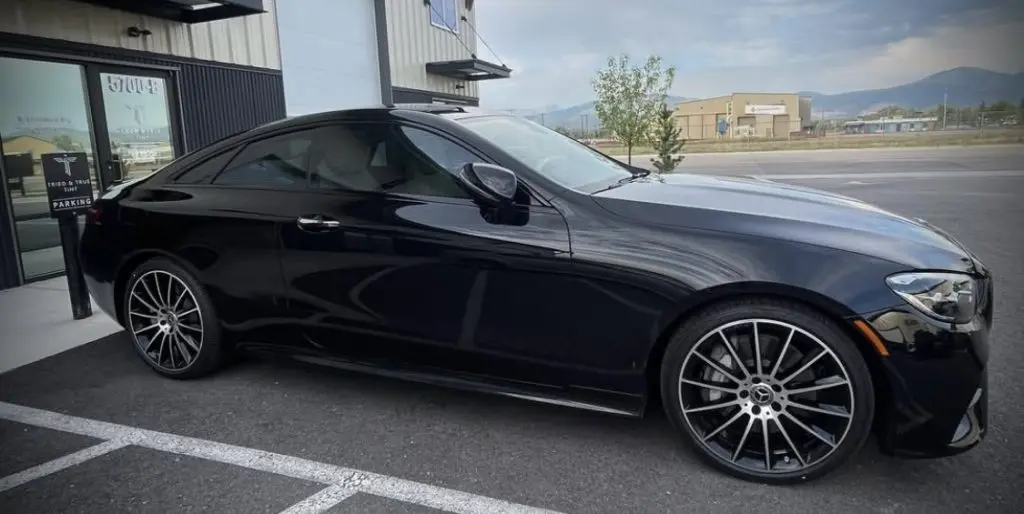
Search data show that queries for “window tinting Missoula MT law” and “legal car window tinting percentage MT” surge every spring as motorists in Missoula and beyond spruce up their cars for summer travels. An accurate reading of the statute, rather than hearsay, keeps fines at bay and preserves a vehicle’s clean lines. The outline below reflects Title 61-9-405 of the Montana Code Annotated, current to May 2025.
Rapid-reference VLT chart
| Glass position | Passenger cars – minimum VLT | MPVs † – minimum VLT | Notes |
| Windscreen | Non-reflective film above the AS-1 line (roughly the top 4 in) | Same | No red, yellow or amber tint |
| Front side | > 24 % | > 24 % | Reflectance ≤ 35 % |
| Rear side | > 14 % | Any factory privacy glass is exempt | Reflectance ≤ 35 % for aftermarket film |
| Rear window | > 14 % | Any factory privacy glass is exempt | Rear-view mirrors on both sides required if tinting is fitted |
† MPV = multipurpose passenger vehicle (SUV, pick-up, van, camper).
Why the numbers matter
Montana measures darkness by visible light transmission (VLT): lower figures mean darker film. Police use a handheld photometer; anything below the statutory threshold attracts a ticket. For saloons and estates, front windows must transmit at least 24 % of incoming light, while glass aft of the B-pillar may drop to 14 %. Multipurpose vehicles leave the factory with privacy glass that is often well below 14 %; the statute exempts manufacturer-installed glazing on those vehicles, but once an owner adds an extra layer of aftermarket film the 14% floor returns. Failing to understand that distinction is the single most common cause of citations.
Reflectivity caps keep the mirror finish off the street
Montana limits exterior reflectance to 35 % across all side and rear windows. Mirror or chrome-look films invariably breach that ceiling, so a conventional dyed or nano-ceramic product remains the safe choice for motorists who fancy a subtler appearance.
Medical exemptions – how they work in practice
Drivers with proven light-sensitivity may apply for a waiver under §61-9-428. A licensed physician, physician assistant or nurse practitioner signs an affidavit; the Highway Patrol or local agency then issues a certificate to be affixed near the vehicle identification number. The waiver states the permitted VLT and carries the officer’s signature. Without that document on the glass, darker-than-legal tint is indefensible in court.
From a practical standpoint, most dermatologists recommend a VLT of 30-35 % in a modern nano-ceramic film. Such products block up to 70 % of solar heat, slash ultraviolet exposure and, crucially, still pass the photometer. They also avoid the murky night-time visibility issues found in limo-black films. In short, a quality 35 % ceramic tint satisfies the majority of medical-waiver patients while sparing them roadside hassle.
Misconceptions that lead to fines
- “The glass was dark when I bought the truck, so extra film is fine.” Adding film to factory privacy glass usually drags VLT below 5 %. Officers treat the result as aftermarket tint and will cite accordingly.
- “I can copy my friend’s 20 % tint from Idaho.” Montana’s limit is 24 % at the front. Out-of-state specifications do not travel with the vehicle.
- “Removing the tint is cheaper than paying the ticket.” A citation often includes an order to present the car for inspection within 14 days; skipping that appointment triggers a separate offence.
Best practice for a clean install
- Measure first, cut once. A reputable window tinting Missoula MT cost shop will read each pane with a photometer before work begins.
- Select film by finished VLT. Remember that window tinting near me sits atop stock glass that already blocks roughly 5–7 % of light. Choose accordingly.
- Mind the dot-matrix. Windscreen frits can lift cheaper films; a high-tack ceramic variant prevents peeling at the AS-1 line.
- Keep documents in the glovebox. Medical waiver on the glass, purchase receipt inside: simple, yet many drivers forget.
Enforcement and penalties
Typical fines range from US $50 to US $200 depending on county. More painful is the repair-and-verify order: it forces removal or replacement within a fortnight and consumes a morning at the courthouse. Insurance companies also frown upon non-compliant modifications, occasionally adding a surcharge at renewal.
Staying stylish and legal
Montana’s thresholds are generous compared with many neighboring states, so there is little aesthetic compromise. A medium-dark ceramic (around 35 % front, 20 % rear) maintains the clean factory look, drops cabin temperature by double-digits in August and passes every road-side test. Reflective and super-dark films, by contrast, invite attention from both law enforcement and insurance adjusters.
Consider home window tinting and commercial window tinting while you’re at it as they can save you a lot in electric bills.
Book a five-minute legal-tint check—free while you wait. A certified meter reading, a quick chat about film options, and peace of mind for the next road trip: ring today or book online.